
Sleep & Wellness
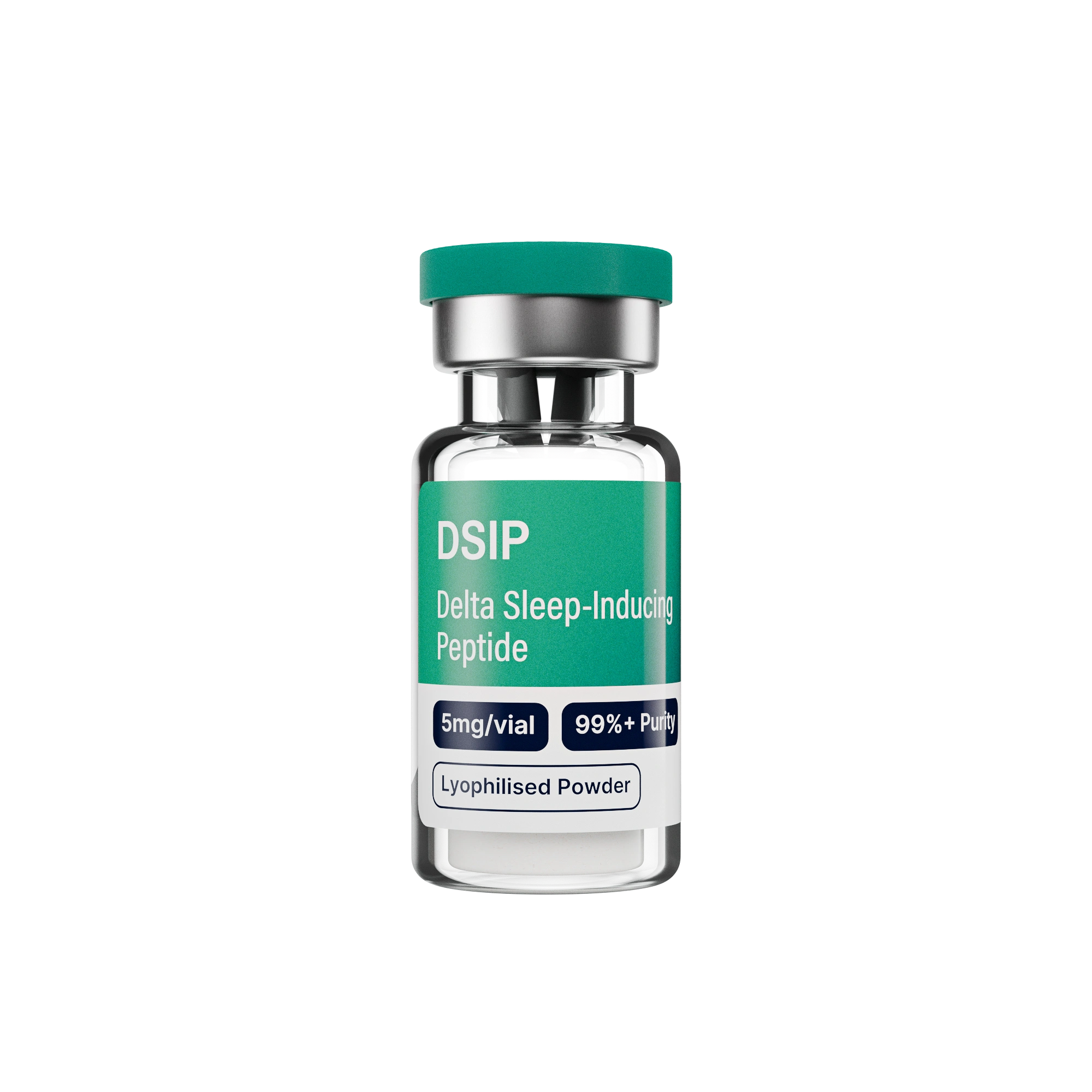
DSIP
Delta Sleep-Inducing Peptide for deep sleep enhancement and stress reduction.
Add to cart
Concerned about product quality when you buy DSIP Europe? Here, every batch is independently tested for purity and identity, with product-specific documentation available for review before shipment.
Modern research has expanded beyond a simple focus on sleep duration. Earlier work, including the National Sleep Foundation’s 2015 sleep-duration recommendations, mainly centered on how many hours people should sleep. More recent studies have shifted attention toward sleep architecture: the structure and distribution of sleep stages throughout the night. Examples include Windred et al. (2024), which concluded that sleep regularity was a more reliable indicator of mortality risk than rest length.
Studies have also examined the role of slow-wave sleep (SWS, often called deep sleep), a stage associated with memory-related and restorative processes. This has contributed to increasing interest in how sleep-cycle composition influences rest quality, rather than evaluating sleep by duration alone.
This has then contributed to research into peptides for sleep, including compounds assessed for their effects on deep-sleep phases.
Sleep is organized into repeating cycles that include light sleep, deep sleep, and REM sleep. Each stage is associated with different physiological processes:


A typical cycle lasts approximately 90 minutes, and most nights contain 4-6 cycles. Slow-wave sleep is defined by delta brain-wave activity and is one of the most thoroughly researched phases of rest architecture.
Research has shown that time spent in deep sleep tends to decline with age. Findings from Ohayon et al. (2004) and Mander et al. (2017) documented age-related reductions in SWS, with some studies reporting substantially lower levels of deep sleep in middle-aged adults compared with younger adults. Researchers have also looked into how factors such as stress, cortisol dysregulation, alcohol consumption, caffeine intake, and evening light exposure can influence the balance of sleep stages.
These findings have contributed to broader attention to sleep peptides and other chemicals linked to deep-sleep regulation.
First isolated and characterized in 1977 from the cerebral venous blood of rabbits during experimentally induced sleep, DSIP (Delta Sleep Inducing Peptide) is a naturally occurring nonapeptide. Since its discovery, it has been studied in connection with sleep regulation, cortisol signaling, growth hormone release, and luteinising hormone (LH) activity.
1977 (Discovery) → 1987 (Hormone Signaling) → 1988 (SWS Research) → 2006 (Major Review)
Research on DSIP has often focused on sleep-stage patterns and linked neuroendocrine pathways, not sedation alone. A number of investigations have looked at the related biological processes. For instance, Iyer et al. (1988) looked into the relationship between DSIP, SWS, and growth hormone activity during sleep in rats. Earlier work by Iyer and McCann (1987) examined growth hormone secretion and luteinising hormone signaling.
The review by Kovalzon and Strekalova (2006) recaps decades of research into DSIP’s reported neuroendocrine effects (interactions between the nervous system and hormone signaling) and notes that several aspects of its biological activity remain unresolved.
Research on DSIP has looked into measures such as sleep onset latency, sleep-stage distribution, and time spent in deep sleep. Together, these indicators point to growing scientific interest in how sleep is organized, not just how long it lasts.
If you are planning a research protocol or looking to buy DSIP Europe, the peptide calculator can help you determine reconstitution concentration, volume per dose, insulin syringe units, and total doses per vial. Simply enter the peptide amount, bacteriostatic water volume, and target dose to generate the corresponding calculations.
Beyond sleep-related work, studies involving Delta Sleep Inducing Peptide have also examined stress-related physiology and neuroendocrine function. Researchers have looked at how hormone transmission, sleep control, and the body’s response to stress function with other biological systems.